Sign 03
Sloping, sagging or uneven floors
You feel it before you see it: a chair that rolls, a cabinet door that swings, a low spot by the back wall. Floors can be measured, which makes this the sign a company is able to put numbers on.
What it looks like
Tilt, dip and hump are three different things
- Tilt: the whole floor runs downhill toward one side of the house. Often the outer edge of the slab has dropped.
- Dip: a low area in one corner or along one wall, sometimes with a gap opening under the baseboard.
- Hump: the middle of the house is higher than the edges. On clay this can be the centre swelling, not the edges sinking.
- Tile cracking in a line across several rooms, or wood and laminate planks separating along one row.
A slope of more than about one percent, roughly an inch in eight feet, is usually enough to notice, according to the Texas Section of the American Society of Civil Engineers.
Other causes
Floors that were never flat
No slab is poured perfectly level. Some of what a survey finds was there the day the house was finished, and nobody has the original readings to compare.
A plumbing leak under the slab wets the clay in one spot and pushes the floor up there. That needs a plumber's leak test before anyone talks about piers.
Wood flooring that cups or buckles is reacting to moisture in the boards and can sit on a slab that has not moved at all.
At the inspection
What a company checks
Relative floor elevations, taken room by room with a digital level and drawn as a map showing the high and low areas.
Whether the low areas match cracks and leaning door frames. A survey on its own is not treated as proof by engineers, because the starting shape is unknown.
Sometimes a second survey months later. The change between two readings is stronger evidence than either one.
If it is the foundation
What repair might involve
A dropped edge is usually lifted on piers set around the outside of the house. Low areas well inside may need piers reached by tunneling under the slab or by opening the floor.
A hump caused by swelling cannot be pushed down. The work there is finding and stopping the water, then waiting.
Lifting is done in small steps to limit new damage, and the engineers' guidelines are frank that it is unlikely to leave a floor perfectly level.
In the meantime
A simple test you can repeat
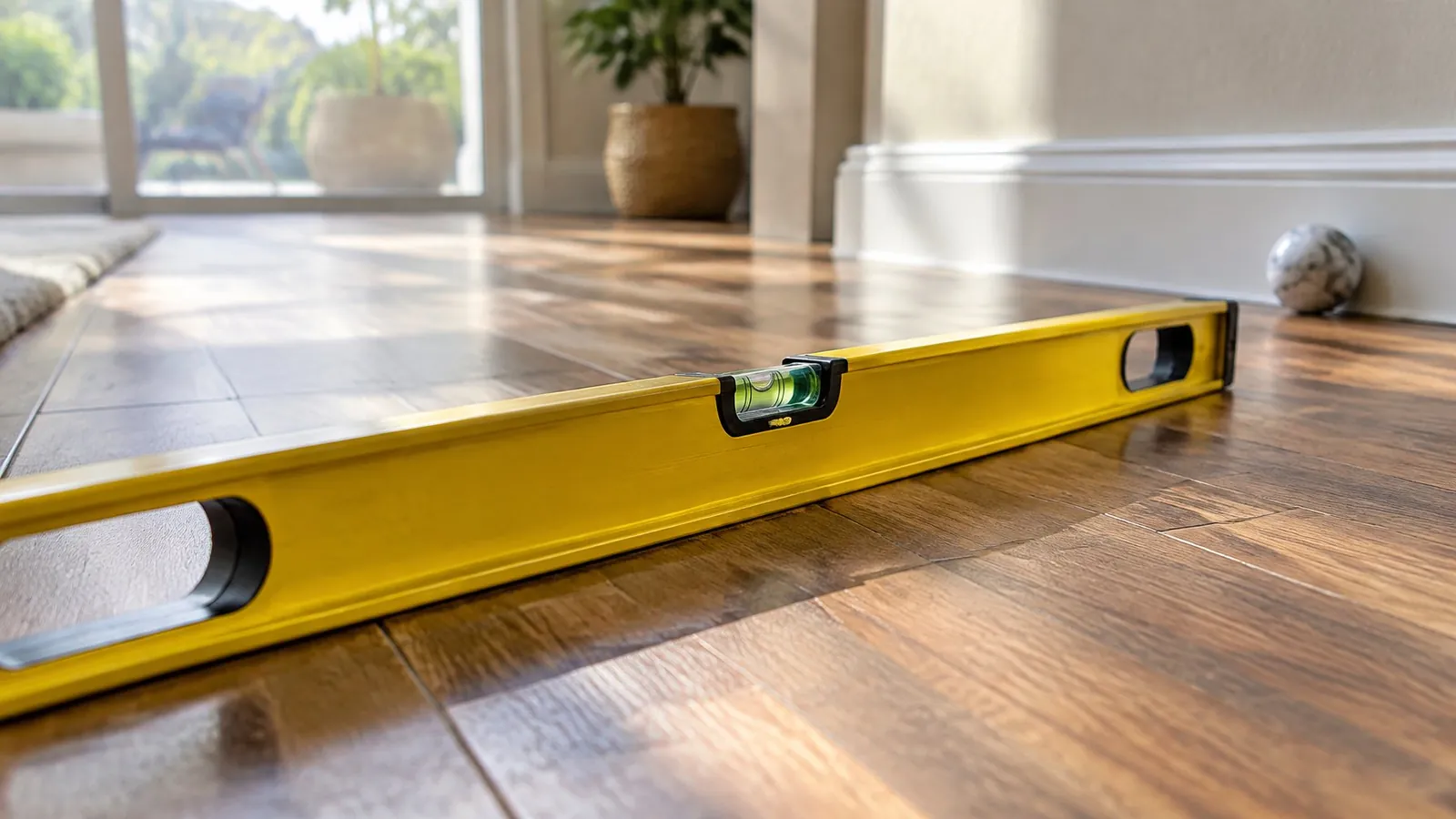
Set a long level, or a marble, in the same three places once a month and write down what happens. Note the weather. A slope that eases after rain and worsens in a dry spell is useful information.
Leave new flooring until the cause is known. Tile laid over a slab that is still moving cracks again.
Foundation repair in Frisco and nearby
Describe the problem, book the inspection
This number is for foundation repair on houses. Say where the cracks are, which doors stick and how long it has been going on. If part of the house shifted all at once, there is a gas smell, or brickwork seems about to come down, clear the house and dial 911 or the gas utility before anything else.
Ready to have someone look at it?
Phone and say what you have noticed. The foundation repair company on the other end is independent of this site and takes on houses in your part of Collin or Denton County. Ask it for a time to come and inspect.
Call (972) 430-3959Your call may be recorded. Read how referrals are paid for and what happens to call details.