Guide
Why foundations move in Frisco
The short answer is the soil. Frisco stands on the Blackland Prairie, named for a dark clay that farmers prized and builders have to respect. The longer answer depends on which side of the city you live on.

Shale and chalk beneath the area
A regional geology report hosted by the city places a Frisco study site near the contact between Eagle Ford shale and Austin Chalk. Its regional description puts younger rock formations generally toward the east and southeast.
The two behave differently. The shale is itself mostly clay, and it weathers into heavy clay soil. The chalk is rock, a soft one, and where it lies close to the surface it gives a pier something firm to rest on.
The soil on top
What the soil survey maps in Frisco
The federal soil survey, available in the Web Soil Survey, includes Austin silty clay at a sampled eastern Frisco location and Branyon clay at a sampled western location. The parcel map can show which mapped soil covers your lot. A soil name is a starting point for the inspection, rather than a diagnosis of the house.
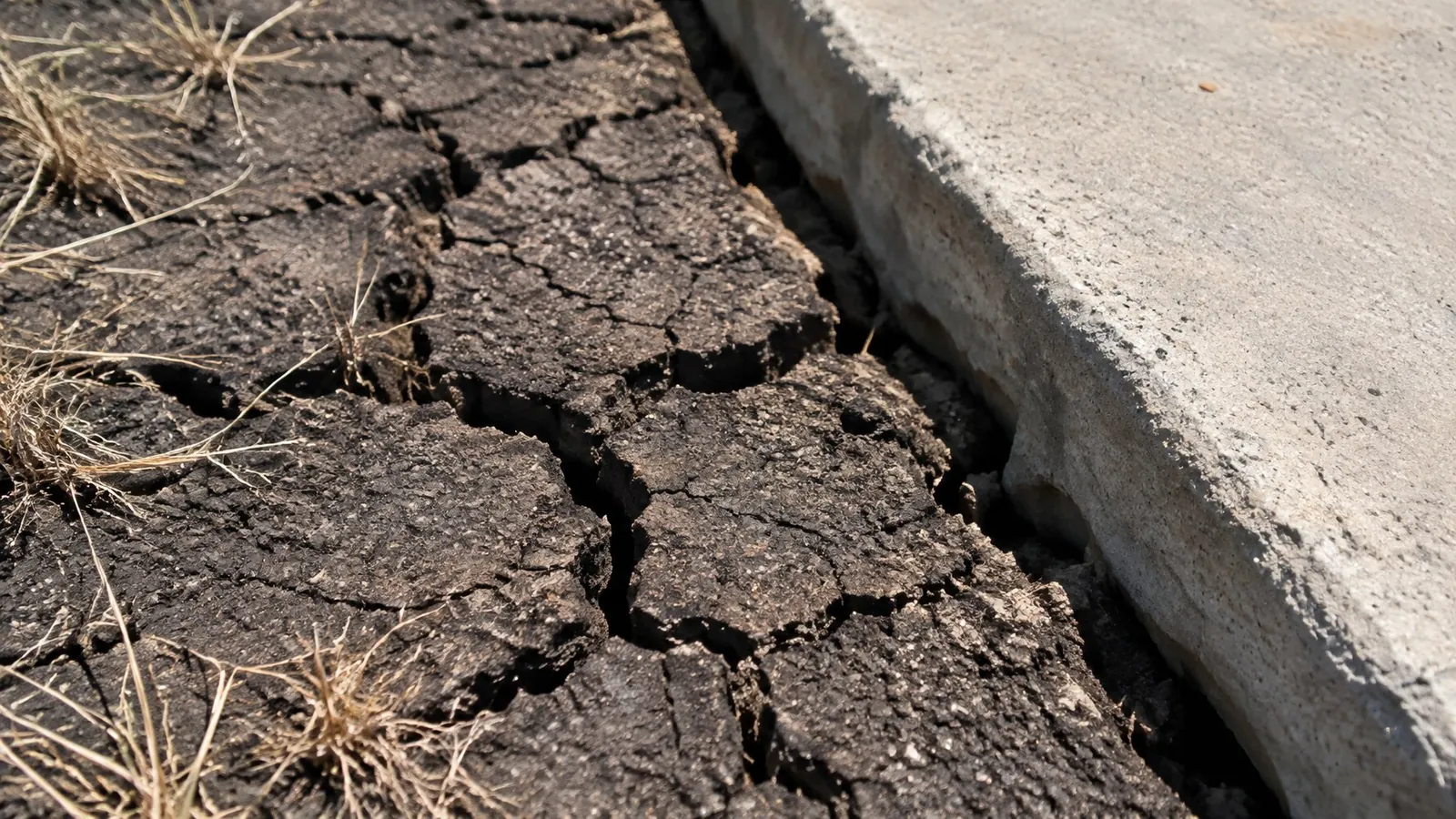
The survey's description of Houston Black clay says what every gardener here has seen. When the soil dries, cracks from half an inch to four inches wide open at the surface and reach a foot or more down. In most years they stay open for 90 to 150 days.
Other chalk-derived soil series in the region include Austin, Stephen and Eddy. Their official descriptions show why the depth to chalk can differ: weathered chalk about two and a half feet down under Austin soil, a little over a foot under Stephen and less than a foot under Eddy in their example profiles. Those examples do not establish the depth beneath a particular Frisco house.
What that does to a house
A slab is a raft on soil that changes size
A slab foundation does not stand on bedrock. It rests on the top few feet of soil, the part that gets wet and dries out. The middle of the slab is sheltered, so the clay under it keeps a fairly steady dampness. The clay under the edges follows the weather.
In a long dry summer the edges lose moisture, the clay shrinks and the rim of the slab is left with less support. After a wet spell the edges swell back, sometimes past where they started. A slab designed for this bends a little and recovers. Trouble starts when one part moves much more than the rest.
- Trees. A large tree near the house draws water from the clay on that side and dries it faster and deeper than the weather would.
- Leaks. A leaking water or drain line under the slab wets one patch of clay and lifts the floor above it.
- Drainage. A downspout, a low spot or a daily sprinkler cycle keeps one wall wet while the others dry.
- Fill. Lots are graded flat before building. Soil that was added and not compacted well settles under the weight.
If your house is only a few years old, read the builder's warranty papers before paying for anything. Movement in a new house may be the builder's to deal with.
Why it matters for a repair
What the ground changes about the job
- How deep piers go
- A pier has to reach soil or rock that does not change with the seasons. Where chalk is a few feet down, that may be shallow. In deep clay over shale it can be much further. Depth is one of the main things that moves the price.
- Which pier is proposed
- Some piers are pushed until the ground resists. Others are drilled to a depth an engineer sets. Local ground decides which makes sense. Repair methods describes each.
- Whether to start with water
- Because moisture drives the movement, engineers' guidelines in Texas say that drainage, watering and tree work may sensibly be tried before structural repair, or instead of it.
- What the engineer needs to know
- For a large repair those guidelines call for soil information from borings on the property. For smaller ones, engineers often rely on what has worked on nearby streets and confirm it as the piers go in.
Your own lot
Look up the soil under your house
Open the Web Soil Survey, start the map, enter your address and draw a box around your block. The Soil Map tab lists the soil names inside the box. Houston Black, Branyon, Heiden, Ferris or Vertel means deep expansive clay. Austin, Stephen or Eddy means chalk is not far down.
The survey was mapped for farming, long before the subdivisions, and builders moved a lot of soil. Treat the name as a starting point for the conversation with the company or engineer, not as a finding about your lot.
Foundation repair in Frisco and nearby
Describe the problem, book the inspection
This number is for foundation repair on houses. Say where the cracks are, which doors stick and how long it has been going on. If part of the house shifted all at once, there is a gas smell, or brickwork seems about to come down, clear the house and dial 911 or the gas utility before anything else.
Ready to have someone look at it?
Phone and say what you have noticed. The foundation repair company on the other end is independent of this site and takes on houses in your part of Collin or Denton County. Ask it for a time to come and inspect.
Call (972) 430-3959Your call may be recorded. Read how referrals are paid for and what happens to call details.